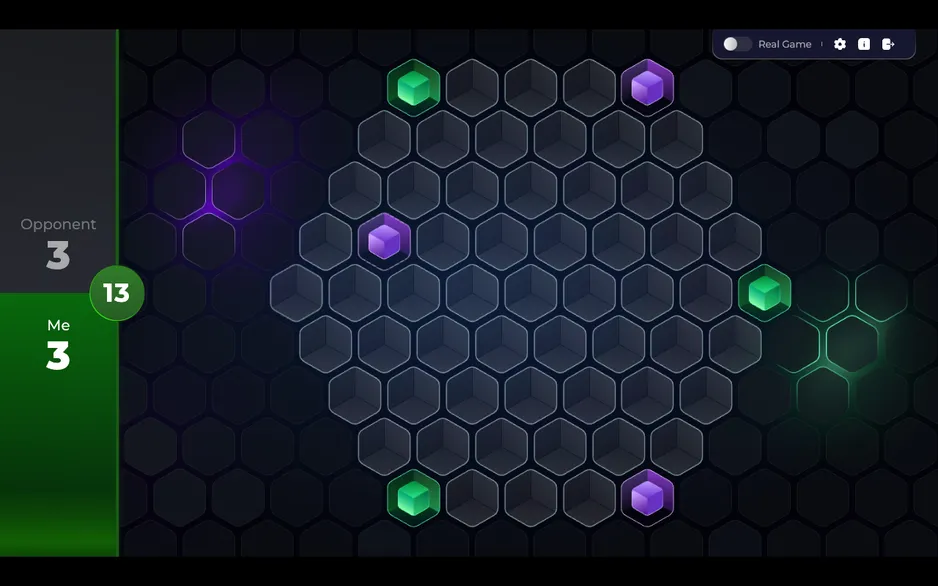
 Demo preview
Hexagon Demo: Clone and Jump Practice on 6 Boards
A clone adds a cube; a jump leaves a hole behind. Hexagon free practice makes that difference visible before a player needs to weigh a paid table, with six completed Hex 61 boards recorded during the demonstration. Score: 8/10 for clear movement cues with meaningful territory choices. Galaxsys provides clear move highlights. The best destination still needs thought about the opponent's reply.
Playing Hexagon for real money
Hexagon practice is a demonstration board rather than a cash table: its cube scores have no money value with results kept separate from a paid match. Licensed operators choose table stakes. The studio states that levels differ by table with the numerical band left to the chosen room. Read the room conditions before entry. Cash rooms are for adults 18+. Set the total entry budget plus the time available for play, then leave at those limits regardless of the last board result.
What Hexagon is
Hexagon is a Galaxsys territory game where cloning grows a side and jumping trades the old position for a more distant landing that may convert enemy cubes nearby. Each reply can reverse a gain. The demonstrated Hex 61 board rewards checking the space left behind as well as the destination that looks attractive now.
How a round plays out
Open the launcher with Play free demo, then use START on the demonstration screen. Leave Real Game switched off during board practice. Click an own cube to reveal its legal destinations, checking the highlights before clicking a spot rather than assuming that a cube which looks active has already been selected for a move. Let the board respond before another selection.
The opponent takes a turn between moves.
A clone leaves the source occupied while adding a nearby piece. A second-wave jump moves further and vacates the source, so the same tempting landing can have a very different cost depending on which cube was used to reach it. Nearby enemy cubes change colour after landing.
Watch those conversions before choosing the next piece.
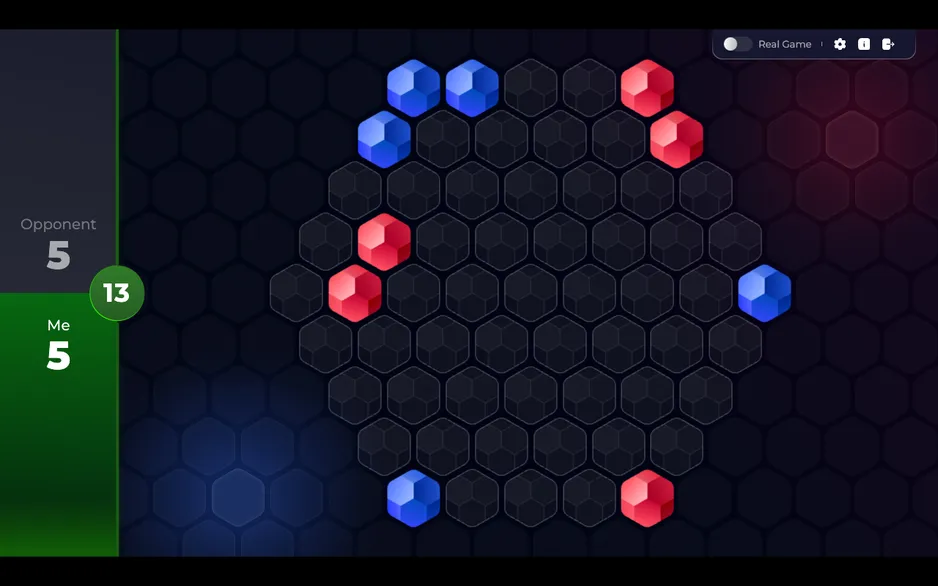
The opening completed board ended 40 cubes to 21. That gives a concrete full-game example of the clone-first exercise, while the final board reached 52 to 9 after the same basic preference for nearby expansion. Cubes are territory, not credits.
A completed score is more useful than counting each conversion as a separate win.
Specifications and return
Skill outcomes and money measures belong to different columns, since a final cube total supplies neither an accepted table charge nor a paid prize. The sample contains complete boards only.
Its unbeaten result offers little guidance about strong opponents in a competitive room.
| Specification or measured result | Value |
|---|---|
| RTP | — |
| Stake range | Table dependent |
| Maximum win / multiplier | — |
| Volatility | — |
| Paylines | Not applicable to territory play |
| Release date / year | — |
| Completed demonstration games | 6 wins; 0 losses or draws |
| Cash stakes / returns | — |
| Completed game | Player cubes | Opponent cubes |
|---|---|---|
| Opening board | 40 | 21 |
| Next board | 44 | 17 |
| Following board | 48 | 13 |
| Next finish | 41 | 20 |
| Later finish | 50 | 11 |
| Final board | 52 | 9 |
Strengths and limits
The clone-or-jump distinction gives every move a clear cost to weigh, though a large conversion can distract from the exposed hole that makes an opponent reply stronger. Legal highlights help with reach. Their job ends at legal reach.
Sustained attention makes the game more demanding than its simple colour changes first suggest.
The phone layout keeps the board in portrait view. Select a cube, pause, then confirm the highlighted destination. Small cells make that pause useful when an attractive conversion sits close to another legal square, especially late in a game when a mistaken jump can open a new route for the opponent.
A board score has no withdrawal value.
More Galaxsys games to try
For another kind of Galaxsys table decision, try matching exposed tile ends, capturing cards while leaving a useful table, or choosing actions for a dealt hand. Each asks for attention beyond a single tap. Learn its score unit before comparing results. The assessment of territory choices and board layouts covers the full strategy trade-off.
Verdict: planning matters more than the first gain
Hexagon keeps 8/10 for distinct movement choices plus clear destination cues, though small cells and timed turns can make a careful position feel rushed. It suits players who enjoy weighing an opponent reply. Instant-result fans should skip the board.
The six demonstration wins are a weak guide to success at paid tables.
How it was tested
The session ran across November 14–15, 2026. It finished six Hex 61 games by taking the first available clone in board order, using a jump when cloning was unavailable while inspection pauses sometimes allowed timeout moves. Completed scores were recorded. An unfinished board was excluded.
Only board scores were supplied.