 Demo preview

Maestro Demo: 100 Flights with a Preset 2.00× Exit
The parrot leaves when Maestro's round ends. Free play lets a preset collect well before that moment, making a paid ticket easy to compare with the final flight height. Score: 7/10. The 100-round record gained practice credits at a fixed exit, while the conductor's music offered no reliable clue about the next stop.
Playing Maestro for real money
Maestro's demo awards FUN rather than cash. The credits are virtual; a successful flight or closing balance has no withdrawal value and its results cannot carry into a paid account at a licensed operator. Real-money entry is restricted to adults 18+. Pick an end time before starting. Keep a separate spending limit for cash play.
The studio card lists $0.4–$400, but the loaded practice rules use 1–100 FUN; the operator sets its own paid range rather than inheriting this demo band automatically. Check the panel's selected amount before entry. Both panels can spend on one flight.
What the conductor game is
Maestro is a Galaxsys crash game built around a flying parrot, where the multiplier climbs until the bird departs and any bet still open is lost. Bets enter before the round starts. Full collection closes an entire ticket. The partial exit leaves some of that ticket in play.
How a parrot round plays out
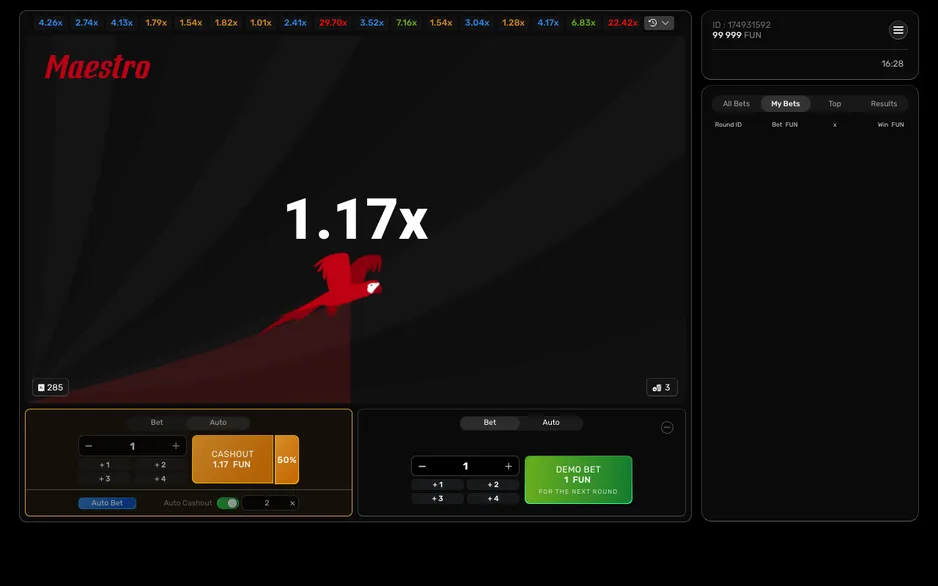
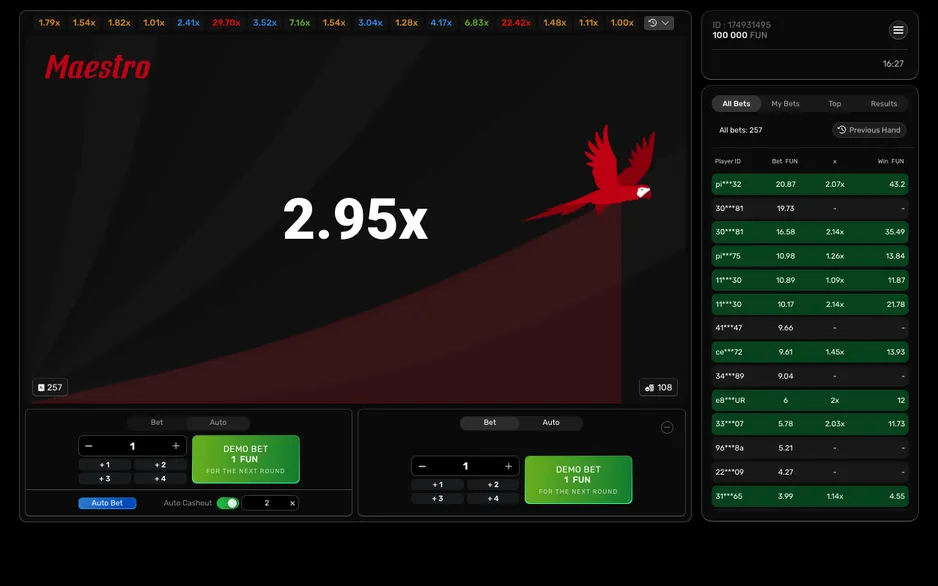
Load the game, select the first panel, open its Auto tab, then choose 1 FUN and a 2.00× exit before placing the bet in the next betting window. Repeat betting can stay disabled. Round 1 paid 2 FUN at that target. The original stake is included. Later flight height changes nothing after full collection.
For a manual exercise, disable the preset before entry and locate the 50% control, then compare the sum paid with the remainder still facing the same flight's sudden ending. A half exit closes only part. The next departure can take the rest. Auto Play schedules future bets instead. Inspect its loss stop before allowing repeated entries.
Specifications and fixed-exit return
The game's return to player belongs to long-run play, whereas the flight bands and collected amounts describe only a short visit under one exit policy at an unchanged stake. The multiplier ceiling is a separate limit. A money cap can bind earlier. These values should be read together before selecting a cash stake. The positive sample offers no forecast.
| Specification or visit measure | Value |
|---|---|
| Official / loaded rules RTP | 98% |
| Studio card cash stakes | $0.4–$400 |
| Loaded demo stake range | 1–100 FUN |
| Published multiplier / loaded cap | 700,000× / 10,000 FUN |
| Volatility | High |
| Paylines | Not used for the parrot's flight |
| Release date / year | — |
| Total staked / returned | 100 / 116 FUN |
| Observed return | 116.00% (small sample, not RTP) |
| Below-target / reaching-target flights | 42 / 58 |
| Longest losing sequence | 4 rounds |
Strengths and limits of the performance
The Auto tab gives the planned exit a clear place before a flight, while separate panels allow different collection points for players who want to compare two bets on the same event. Partial collection adds another useful control.
The musical scene adds little depth to the core cashout loop.
Both panels share the bird's departure. Sound can be changed between entries. Top results recall earlier flights rather than predict new ones.
More Galaxsys flight and crash games
The plane with a half-collection option is a close comparison for partial exits, while rocket-themed timed collection changes the flight scene without removing the need to collect. The runway's rising payout offers a grounded setting instead. Each keeps a sudden stopping event. Compare their panels during free practice. The assessment of Maestro's parrot flights and controls examines this version more closely.
Verdict: useful presets in a familiar loop
The 7/10 verdict favors flexible exits plus practical repetition limits, though fans of a deeper music game may find that the conductor supplies a theme around a familiar collect-or-wait mechanic. Crash players who enjoy presets are well matched.
Anyone wanting rhythm-based skill should skip this game.
Keeping the target fixed clarifies its effect. Winning practice credits does not establish a profitable method.
How the Maestro flights were tested
On November 14, 2026, the session entered 100 rounds at 1 FUN on the first panel with full automatic collection at 2.00×, checking each final return against the displayed balance. The unused panel carried no second bet. Final flight heights were recorded separately. Repeat-entry controls were inspected after play only. The highest flight ended at 94.28×.