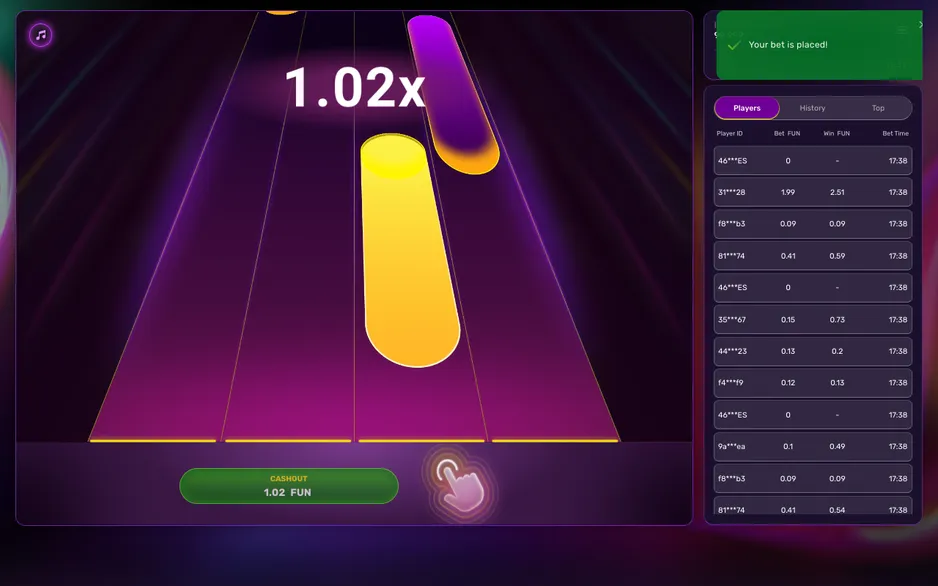
 Demo previewPlay free demoVirtual credits · No registration · 18+
Play Me
Play for real money ↗Operator links on this page are affiliate links. The site may earn a commission, which does not affect ratings or the published facts.
Play Me — Game Specifications
| Parameter | Value |
|---|---|
| RTP | 97% |
| License | MGA/B2B/592/2018 |
| Max Bet | 100 FUN (demo) |
| Max Win | 10,000 FUN (demo) |
| Min Bet | 1 FUN (demo) |
| Provider | Galaxsys |
| Game Type | Music-themed hold-and-release crash |
| Platforms | Desktop, Mobile, Tablet |
| Technology | HTML5 |
| Volatility | High (published label) |
| Game Category | Turbo Games |
Table of Contents
Play Me Game Review
Hold a piano tile, then let go before the rising odds stop. Play Me by Galaxsys turns that action into a crash-style round, with release pausing the value rather than collecting it outright. Score: 7.5/10. You get a useful break between holding and cashout, though mistaking release for a finished bet is an easy early mistake.
Release freezes the odds; Cashout finishes the round.
Holding and collecting are separate actions
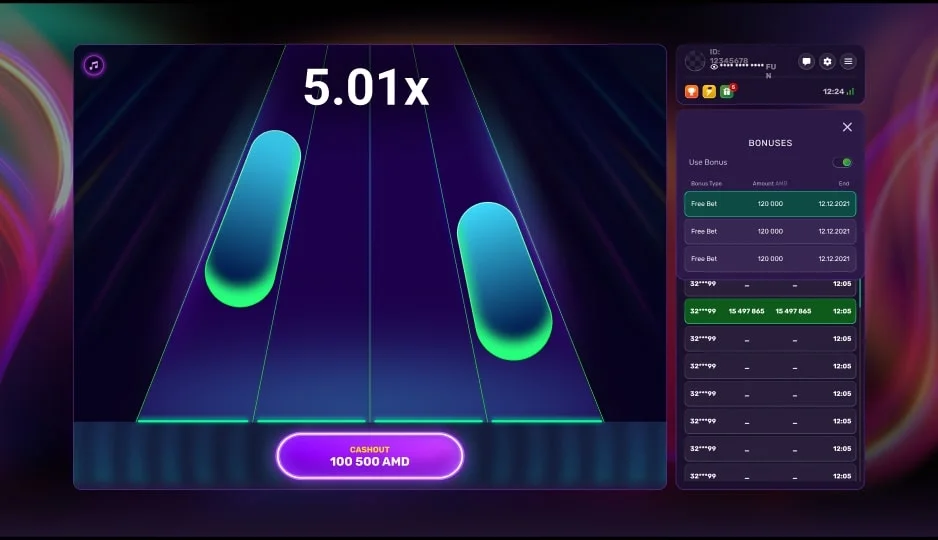
Choose the stake, then press and hold a tile to start the round while its multiplier grows until you release or the game stops it first. A stop during the hold loses. Release pauses the value. The player can then collect or hold another tile to continue from the same point. A new hold risks the amount again, so the pause is a decision point rather than a completed payout.
The rules state 97% return to player. The published risk label is High, so frequent small collections should still be weighed against the chance of losing a hold. Current demo limits are 1–100 FUN with a 10,000 FUN money cap. Older rules show 0.4–400 FUN and 40,000 FUN. Another official spec lists a 1,000× maximum, so the active money cap remains worth checking instead of relying on a headline multiplier alone.
Missing a scrolling tile has no effect on the game.
Demo: release after a short hold
Use the piano practice page and release guide to learn the pause before final collection. The trial played 100 rounds at 1 FUN, requested a one-second hold, released, then collected; these results are a small sample, not RTP.
| Session measure | Result |
|---|---|
| Rounds | 100 |
| Bet per round | 1 FUN |
| Total bet | 100.00 FUN |
| Total returned | 91.22 FUN |
| Observed return | 91.22% (small sample, not RTP) |
| Payout rate | 83.00% |
| Return above bet | 83.00% |
| Largest return | 3.42×bet |
| Longest losing run | 2 |
Round 96 returned 3.42 FUN after a natural Boost, standing out in a run where most winning holds paid only a little more than the stake. The whole demo returned 91.22 FUN. Payouts arrived on 83 rounds. Just one collected return exceeded 2×bet. The longest losing run was 2 rounds. Frequent small collections therefore left the balance below its starting point despite a high share of winning rounds.
What changes during Boost?
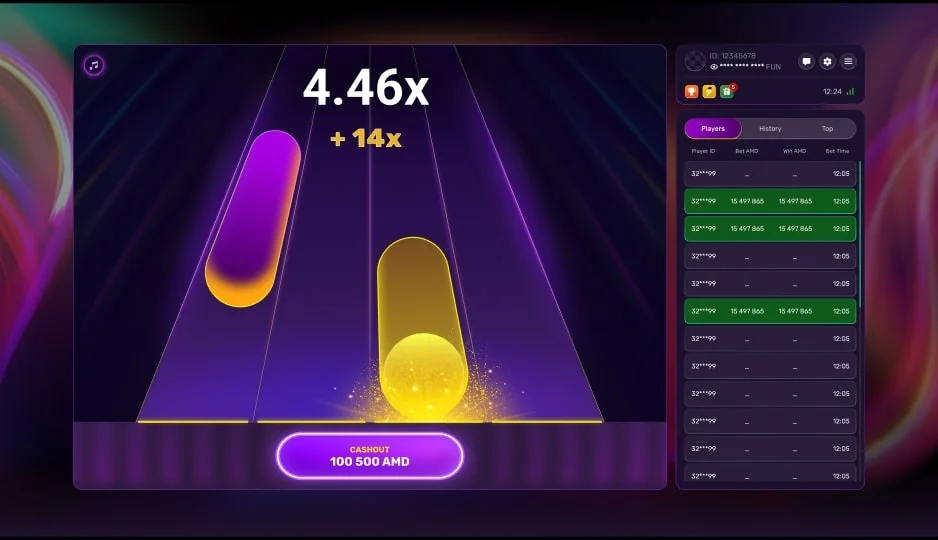
Boost can activate at random during a hold, turning the tile gold with sparkling effects while the odds rise faster than in the ordinary part of the round. The rules protect the hold while Boost is active. That protection ends with the mode. The tile then returns to its normal color. An earlier Boost gives no reason to assume the next ordinary hold has the same protection.
| Action or state | Effect | Next decision |
|---|---|---|
| Hold a tile | Starts or resumes growth | Release before an ordinary stop. |
| Release | Pauses the current odds | Collect or resume the risk. |
| Cashout | Transfers the final return | Review the next stake separately. |
| Boost active | Accelerates protected growth | Watch for the return to normal. |
| Miss a tile | Leaves the game unaffected | Choose when to hold again. |
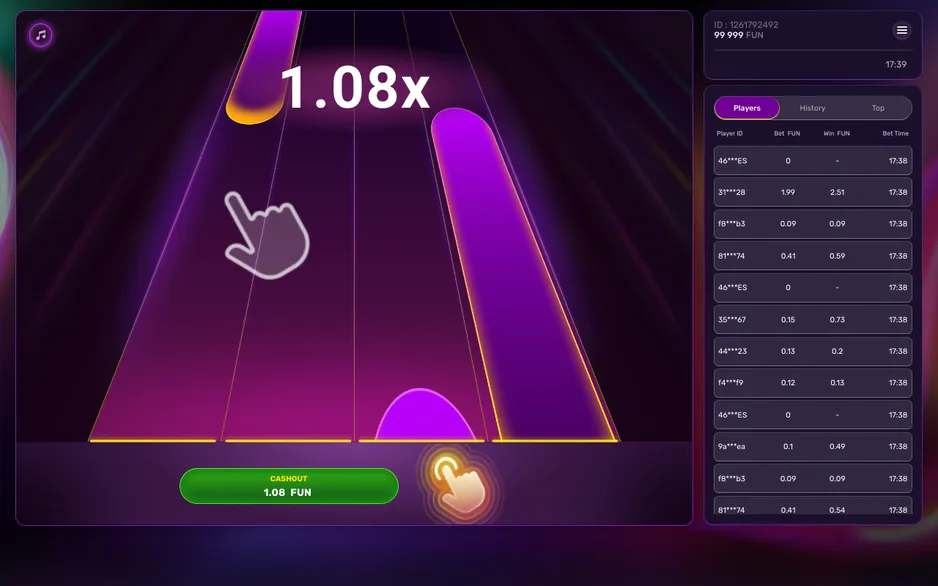
The trial recorded a Boost only in round 96. The screenshot shows an ordinary tile hold. The actual credited feature result appears in History. A special mode can add a stronger return, though its random arrival makes waiting for it an unreliable way to plan a short session.
Music gives pace, not a better result
Tiles scroll in time with the background music, giving the screen a rhythm-game feel even though missing a tile does not count as a failed note or a lost chance. The stake begins with a hold. The game can stop odds at the starting value of 1.00×. A confident sense of rhythm therefore offers little help in identifying how long a fresh ordinary hold will remain safe.
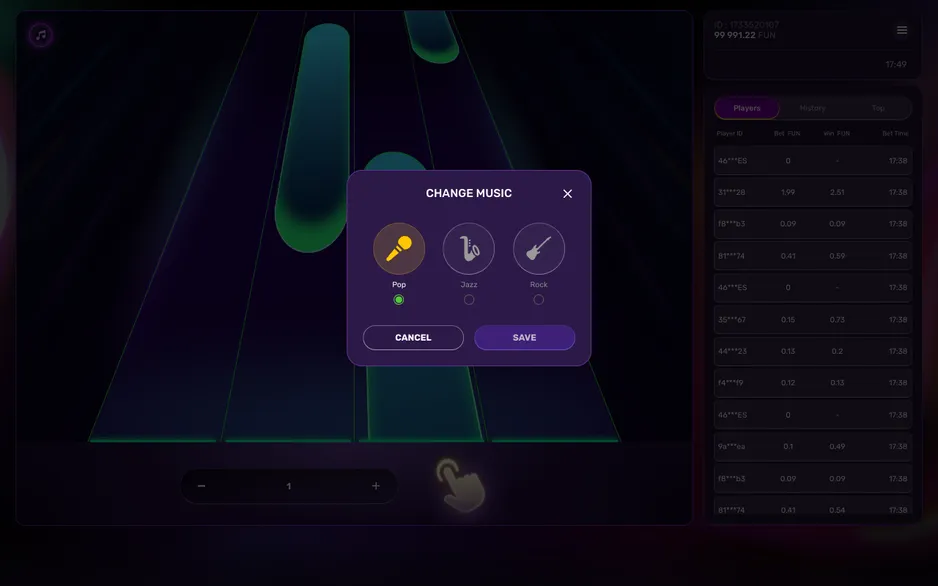
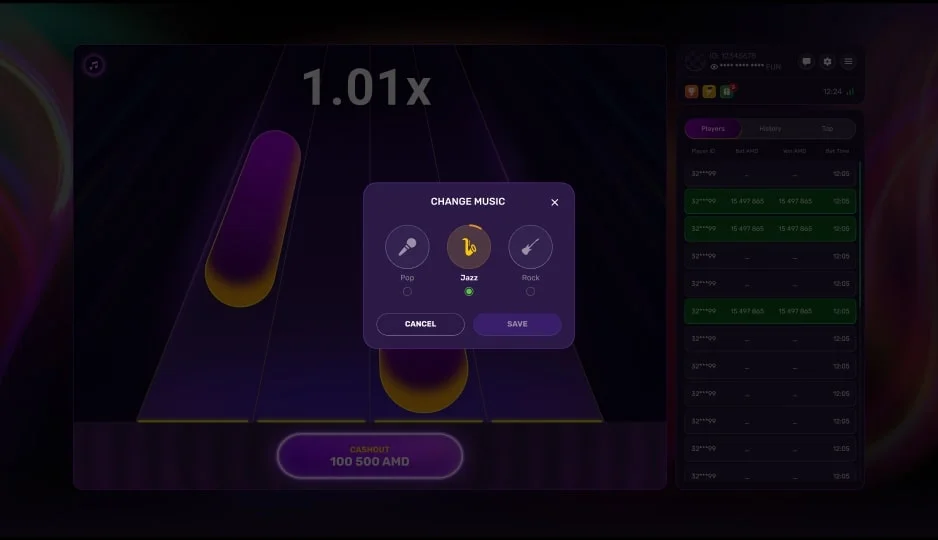
The music selection menu was opened after the measured session. Its choices change the backing track rather than providing a tested route to higher returns. Mobile support includes touch controls. A small screen makes the distinction between release and collection especially useful to practice, because the final action still needs a deliberate tap after the fingers leave the held tile.
Check for the completed cashout before treating a pause as a win.
Player fit and the final rating
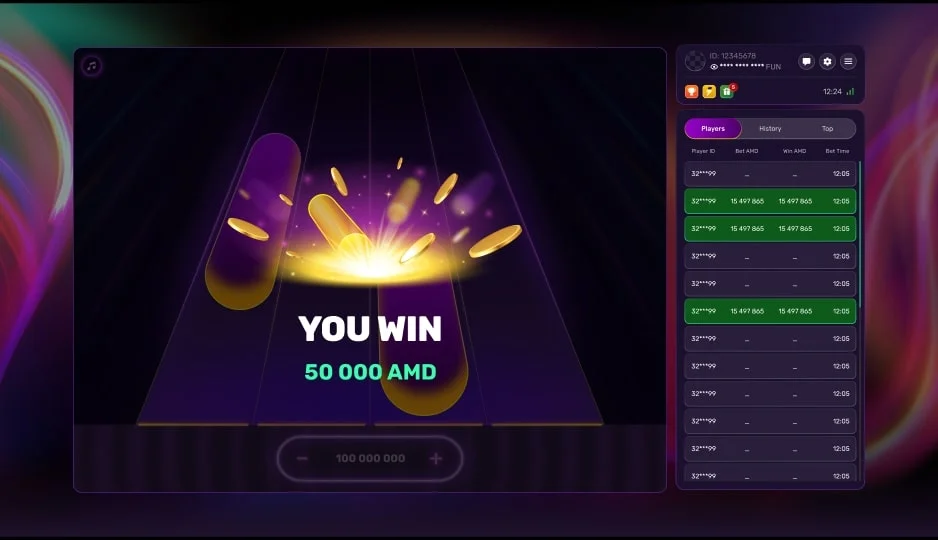
This game suits players who enjoy making a short hold followed by a calm decision about collecting. Fans of score-based music games may find the resemblance misleading, since the outcome is a wager rather than a reward for hitting every note. History records the earlier completed holds. Top shows earlier public highs. Neither display identifies when the next hold will stop or when Boost will arrive.
- Releasing alone leaves the round open.
- Many small wins can still fail to cover the losing holds.
- Resuming after a pause puts the accumulated amount back at risk.
The 7.5/10 score values the pause-and-choose design plus the contrast between ordinary holds and Boost, though the extra collection step can catch a new player out. The trial's fixed hold was an observation plan. It is far too small to establish the best hold length. If the controls remain confusing after practice, stop before using cash. Paid piano rounds are intended for adults aged 18+ only. Decide a spending ceiling before the first held note. Plan an end time as well. Leave both unchanged after an early stop. The operator supplies its own deposit and withdrawal terms.
Screenshots of Play Me
Frequently Asked Questions — Play Me
What is the RTP of Play Me?
The game states 97% RTP. A short set of fixed holds cannot establish a long-run return or the best hold duration.
Does releasing a tile collect the money?
No, release freezes the odds. Cashout is a separate action; holding another tile resumes growth with the amount still at risk.
How does Boost work?
Boost randomly speeds growth during a hold and protects it while active. Ordinary risk returns once the tile leaves Boost.
What are the current demo limits?
The captured rules allow 1–100 FUN bets and cap winnings at 10,000 FUN. Older rules list larger limits.
Can the piano game be tried free?
Yes, this page includes a virtual-credit demo. Practice helps distinguish pausing the odds from collecting the round.
Does missing a tile cause a loss?
No, the rules say missed tiles have no effect. A hold places or continues the wager; an ordinary crash during it loses.
How was Play Me tested?
The demo ran 100 rounds at 1 FUN with a requested one-second hold, release and immediate collection. One natural Boost appeared.
Player rating
Player comments
Only registered players can post comments.
No comments yet. Share how the game played for you.